Physical AI’s factory test: connecting production to material movement
Produced with support from Rockwell Automation
This show takeover was sponsored by our Automation Fair coverage partner, Rockwell Automation. See more coverage on our Automation Fair page.
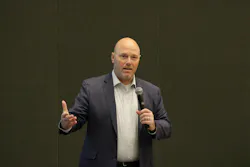
Manufacturers seeking more autonomous operations should look for opportunities to automate the movement of materials around the factory, Rockwell's Greg Gernert noted in a presentation at Automation Fair 2026 focused on physical artificial intelligence and production logistics.
Even highly automated plants still depend on workers driving forklifts and pushing carts between production stages, said the vice president and general manager, motion, with Rockwell Automation. Connecting those activities with manufacturing software offers an opportunity to improve productivity without attempting a wholesale conversion to autonomous operations.
“Even at that level, in those most highly advanced manufacturing facilities, there's still opportunity,” Gernert said, while detailing a recent visit to a customer’s plant that exemplified Rockwell Automation’s approach to combining robotics, software, simulation and consulting into a complete automation program. The company calls that combination Production Logistics, with an emphasis on coordinating the physical movement of goods and the information governing production.
Physical AI gives equipment a way to respond
Gernert described physical AI through the operation of an autonomous mobile robot. It detects its surroundings, determines what to do and then moves, stops or delivers material. “It's sensing what's around it," he said. "It's thinking what to do. It's acting on it.”
The same principles could apply to machines and production lines responding to changing conditions, he said, sometimes independently and sometimes with human involvement.
Rockwell Automation’s framework in these efforts consists of three activities: simulation, orchestration and movement. Digital twins represent equipment and workflows; orchestration coordinates activity across systems; robots and other equipment execute material movement.
Twinsburg supplied the business case
That coordination must accommodate existing operations, of course, including forklifts and workers moving carts, Gernert said. He cited Rockwell Automation’s Twinsburg, Ohio, facility as an example. An initial deployment introduced autonomous material movement. A second phase connected the robots with the plant’s manufacturing execution system to align deliveries with production needs.
Gernert said the changes produced positive returns and reduced floor-space requirements and work-in-process inventory. Lower inventory also improved working capital, he said. “We're not deploying the technology just to deploy the technology for the sake of technology,” he said.
Responding to a question, he estimated that the two phases were roughly four to six months apart. Benefits from the first phase began appearing in less than a month, he noted, although he did not identify that period as the investment’s payback time.
Workers previously assigned to pushing carts were moved into more valuable plant jobs, rather than laid off, Gernert added.
The loading dock remains a difficult boundary
Expansion beyond a pilot varies considerably project by project, he said. Some customers scaled deployments within a quarter; others took a year. Larger installations, including automotive applications involving more than 100 robots, require different implementation schedules.
Gernert also acknowledged limits. Truck loading and unloading remains difficult because of varying freight arrangements, pallet sizes, unstable loads and safety requirements. “Truck loading and unloading is one of the more challenging aspects of autonomous material movement.” (At the facilities he discussed, outbound truck loading remained manual.)
His account nevertheless identified material movement as a current investment target, while leaving full autonomy as a longer-term objective for manufacturers pursuing that goal.
An ongoing challenge? For sure. But we’re moving in the right direction.